


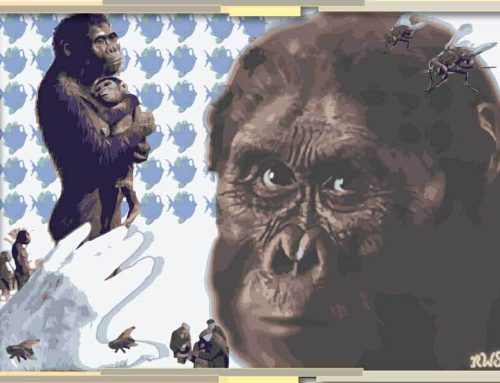
Artwork © Robert Fleming
Timetables
The service shed seemed flung onto the sun-blasted rail corridor. It hugged the train tracks too closely, as though the railway planner had been a poor judge of distances. Its four tumbledown grey walls, all together no bigger than a cabin and yet the only thing taller than a corn stalk for miles, housed tools and snapped rail ties, a lever on the wall that activated an emergency signal, and a calendar of presidential portraits that still showed December 2002 and the faded stare of a long-dead demagogue. Out behind the shed crawled a sad drip of river suffocated by drought and knotweed.
A man in a blue work shirt and pants sat before the shed in a folding chair and faced the tracks. An embroidered patch on his chest read Gregory. He kicked up the chair’s front legs and leaned back. A lip of shade from the shed’s roof cut across his knees.
He lazed a look west down the tracks, then east, then checked his watch. He angled his helmet over his brow and closed his eyes.
An identically dressed man scraped out from behind the shed.
“Swear to God my piss didn’t touch the ground,” the man whose patch read Dane declared. “Sun zapped it.”
Dane approached the tracks, his shadow short and stunted, and spat on the blackened steel. The spittle sizzled and writhed and was gone.
“Goddamn,” Dane cussed. “Must be about 110 degrees. And not a cloud to be seen. Bea’s garden’s a tinderbox.” He shook his head. “That river back there’s toast. Ain’t never seen an October like this.”
He bent into a chair beside Gregory’s. An abandoned game of checkers and a can of heat-fouled Red Bull lay on a sawhorse set up between them.
Dane took a pack of cigarettes from his shirt pocket. He fitted one between his lips and offered another to Gregory, who drowsed with his hands clasped over his flat stomach.
“Hey,” Dane said.
Gregory tilted his head back and lifted an eyelid like a slumbering dog. He took the cigarette. Dane lit them and fanned his legs out as he sat back. He removed his helmet and hung it on his knee, sliding a palm over his bare head and wiping the sweat on his thigh.
They sat in silence. Sunrays atomized the smoke as it rose above the shed.
Dane tapped his feet. He leaned forward and looked both ways down the tracks.
“What’s the time?”
Gregory peeked at his watch.
“Quarter past two.”
“Only 20 minutes ’til next scheduled,” Dane said and grinned. He tapped the cigarette ash into the dirt. “Your ghost train ain’t coming.”
Gregory drank the Red Bull. Dane grimaced.
They smoked. Dane drummed on his knee, ash sprinkling his boot, and watched two hawks circle the desiccated cornfields opposite the tracks.
“Who told you about this unscheduled train, anyway? Someone trustworthy?”
“Someone who’d know.”
“How can you trust them if they broke someone’s trust telling you?”
“They didn’t break anyone’s trust telling me,” Gregory said with exasperation. He crushed the cigarette into his boot heel and dropped it in the dirt. “It’s the government. We’re entitled to their secrets.”
Dane squinted into the sweltering sky and pondered. He searched for the hawks, but they were gone. He scratched his chin.
“And what’s it supposed to be carrying?”
Gregory took a red checker from the board and began tumbling it between his knuckles. He raised an eyebrow at Dane.
Dane guffawed.
“Don’t tell me you believe those drama queens on TV! They scare people for a living.”
“I told you that I have it on good authority.”
Dane narrowed his eyes at him.
“Who? You the nephew of a spook all of a sudden?”
Gregory shrugged.
“And don’t you think management would’ve let something slip? How’re they gonna keep some big operation from the ones running the trains?”
“We work the tracks, not the trains. They don’t need to tell us anything they don’t want us knowing.”
Gregory jerked the checker between his knuckles.
Dane shook his head.
“Well, if your secret train somehow happens to come down that track, I bet it’s carrying troops out west. ‘Political prisoners’ or whatever else they’re flapping about on cable is just a bunch of bullshit.” He went to puff at his cigarette but it had burned down to nothing. “Besides, I’ve got no politics, hell, I don’t even vote, but I wouldn’t protest. Things are going to hell in a handbasket out there.”
“Where’d you read that?”
Dane looked at him sideways.
“It’s reliable. There’s pictures and videos all over the internet.” He flicked the butt onto the tracks. “You know what I haven’t seen? People being herded into trains and shipped off to camps. You can’t tell me that wouldn’t make it online somewhere.”
Dane cocked an eye at him, waiting for his concession.
Gregory opened his mouth to respond when a distant, metallic screech came from the east.
Their heads snapped to the sound. Gregory checked his watch.
“2:28,” he said.
Dane looked at him. The challenge was gone from his face.
“Could be the 2:35’s early.”
They squinted.
“Light’s off,” Dane mumbled. “And no whistle.”
He stood up and put his helmet on, watching the train grow larger as it barreled toward them.
“Cover your face,” Gregory urged him over the wheels’ rising shriek.
“Huh?”
“Cover your face!” he yelled. “Ever heard of loose ends? We’re nothing to them.”
“Man, I’m union,” Dane shouted. “They gonna fire me just for standing here and doing my job?”
Gregory shook his head. He pulled his gaiter up over his nose.
Dane watched him. He turned his head back to the train as it flew at them. His teeth gnawed at his upper lip. The shed’s walls began to tremble.
“Well shit!”
He catapulted himself past Gregory and disappeared behind the shed.
Gregory stood. He cracked the shed door behind his chair as though he was going inside and angled his body behind it.
The cab blazed by. A gust of hot air and dust blasted his face. Gregory leaned out of the doorway, his face downcast beneath the helmet but his eyes angled up.
The train’s windows were tinted. Behind them were barely discernible shapes: vertical bars and the round contours of shoulders and heads packed tightly together. He squinted, his body listing forward as though ensnared by the train’s gravity.
The last car shot by. A door at its rear slid open. The figure of a man appeared in the shaded vestibule. A long gun was slung across his front.
Their eyes met. The man put his fingers to his right ear and said something.
“Shit,” Gregory muttered.
The train sped on until it was a grey thumbprint on the horizon. Gregory watched it shimmer into the wavering heat, its metallic wail diminishing.
Dane poked his head out from behind the shed. He stepped out gingerly and stood before his chair. His cautious gaze followed the vanishing train.
The shed’s shadow had elongated, subsuming them both. The air was cooler. From the east echoed the whistle of the 2:35.
“I recorded the son of a bitch,” Dane whispered triumphantly, holding out his phone to Gregory and playing the video of the train passing. “Were those bars behind the windows? Did you see that shit?”
Gregory did not answer him. His eyes were locked on a point across the tracks.
“I’d upload it now but there’s no damn service out here.”
He looked up and saw Gregory staring. Dane followed his line of sight to the service road that cut toward the shed through the cornfields.
He squinted. A lone black SUV with tinted windows and no plates, its paint spitting back the sun’s glare, trundled toward them through the dust. His mouth went flat.
The emergency brakes of the 2:35 bit the tracks far out of sight of the shed. Their steel scream pierced the sky over the empty railway, loud enough to muffle the defiance of any sound.
Colby Galliher writes about politics, inspired by his years living and working in the U.S. capital, and conservation, inspired by his time trying to get away from it.
Robert Fleming is a digital artist and visual poet from Lewes, DE. His books are White Noir, an Amazon best seller and Con-Way in 4 in 1 #4. Founding/contributing editor of Old Scratch Press and editor of Instant Noodles.



Leave A Comment