


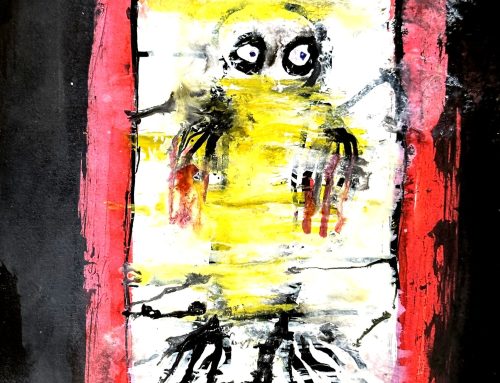
Artwork © Richard Spisak
Chapter 25
Ensconced I am within this thousand dollar room–a thousand on this isle granting one impoverished efficiency. It is just above the streets, and no better than this, not that it should necessarily be otherwise. Nothing needs to be otherwise. There is no imperative for anything unless it is contentment with what is. A meager unfurnished room on a nominal tier, it is redolent of the streets, and no loftier than this. Far from the desideratum, it is, but how in a world so needy as this should I in any way get what I want? As all I can see is what is in front of me, and the good of anything having to be an appraisal of that which is long term, I know not that which is good for me any more than I know what is good for anyone else.
 With my value judgments, attitudes, priorities, and habits– the wont of my being– so different, why should my condition also separate me completely from the vast mass of men? Should I be out of reach of the wafting cloud of urine molecules rising up to my window? Instead of the window revealing, below, a man donned in plastic bags for a rain coat, should a wall be concealing that he is in a dumpster rummaging for substance that might have been erroneously thrown out with the trash? Should it never reveal another bedded on the hard sidewalk, embedded and inured into the hardness of life? It is the hardness of life and those who experience it more fully that deserve to be seen despite the reflex to recoil and efface it from memory.
Obtaining is being obtained, and my attainment is not to be tamed, not to be a worker bee buzzing around to buy things and paying dearly in indentured servitude, but to splash words more wildly, perhaps more pultritudinously, but definitely further in abstraction than Suda the Thai elephant when drawing on canvas. An obscure fumbling original I am instead of a famous epigone, but that is the way it is. That is the way it must be. It is what I must do, despite the survivalistic impulse to be in safer and more affluent terrain so innate. Here there are two persistent flies, but it is the metaphorical one of incessant discontent of a solipsistic mind wishing for more that must be constantly brushed away. Here rain and wind buffet windows instead of being. Here radio buffets my aching head ending any tranquil aspirations.
 Thoreau may have claimed that all news is gossip but such cavalier repudiation of that which affects so many seems particularly brutish and unkind. That is not to say that it did not serve him well. It allowed him to retreat in nature and explore that which one might only appreciate when free of societal roles, obligations, and other extraneous entanglements that are the strangulation of thought. So news rains down from the radio: Bangladeshis of janitorial aspirations needing to provide for families being lured unwittingly by recruiters into forfeiting their lives in fighting for Russia in Ukraine. Yes, I need to warn a Philippine teacher whom I know, now in Uzbekistan, that contractual arrangements of men can be lethal. More ICE protesters in Minneapolis brutally assaulted and more of this subsequent governmental subterfuge and obfuscation: so National Public Radio reports. Did not Father David, the Ecumenical priest, arrange a protest around the King Kamehameha I statue over one such death that I walked through to get to work? Trump inebriated in power and fame, so the gossip goes, and in this obsession slaughtering lives to fuel a bloated ego: thank god for mortality, as it is the only way to remove such gargantuan leeches on public discourse. It all reigns as tempest from the radio. No , there is no harmony for consciousness. Consciousness is not restful sleep but mind flummoxed when envisaging ideals and seeing such fissures, such grand deficiencies, of the real world,
 Immediately above the streets is my only vantage point. Whether it is more above or in them is merely a perspective based on mood from thought a priori of more pleasant or painful happenings experienced or imagined. Normally, rain in Honolulu feels like being a house plant that is misted coldly but today it is sometimes a steady onslaught. As I hear the rain, feel the cold (or what passes as cold on this Hawaiian island), and think of the weather I wonder whether life should have ever existed. Certainly the query cannot be answered in the scope of this diminutive life but it seems that if all living beings past and present were added together–the 8 billion humans now, the 100 billion before, the hominids all the way back to Australopithecus 4 million years earlier and every animal, plant, and insect in between, and the
 earliest of animal life from fishes and sponges, there would be a plausible answer. But the numbers are like the stars and the variables are so myriad that in the context of thought it is impossible to make even a rational conjecture unless I argue that if I in my more privileged life cannot decipher even for myself if my own life is good or bad then it would have to be bad. And yet every animal has surely basked in sun and been caressed lightly by wind, and every fish has felt a warm or cool wave or witnessed the beauty of plankton teeming from a coral reef if not a thermal vent.
Besides the two, others are below, not just on this street but every street of this usually warm metropolis. Most are mad. The streets and the loneliness, even more than chemical imbalances and tragedy, have made them so. Some are of normal background that early on was ruined by tragedies of abuse and apathy often leading to chemical dependency, and all corollaries leading to expedited physical and mental descent. Some suffer the traumas of wars and exploitation or incarceration with a level of mental predation equal to physical predation of the jungles.
To those immersed in society, they are merely mounds of flesh littering the sidewalks, their hair and clothing absorbing the cold rain for a time before being unable to absorb anything more–viruses and bacteria absorbing them eventually. They sleep on expansive window sills like ledges on the ground levels of office buildings and on and under every bench of every bus stop. To further their ordeal, they hear expletives yelled into the air and hear nocturnal cries of animals competing for territory, food, and mating rights to preserve short term life and genetic traces of themselves for posterity. Theirs is knowledge of social predation better than any sociologist. At the convenience store an hour earlier one of them on the streets said “Uncle will you buy me a soda”? The tone was of one needing to know that there was a bit of compassion in the world than the wish to quench thirst, but as anything can happen, cowardly I turned away– apathy being the greatest of all brutes.
“He ain’t your relative and you are homeless. He ain’t gonna do anything for you”. The response was prescient enough.
Unlike Minneapolis in its blizzards, the city of Honolulu is today paralyzed by a winter storm of mostly light rain and strong, intermittent gusts; unlike its residents trudging through the snow to confront ICE agents, a paralysis of mental faculties keeps me from decency. Conscience with its regret of the past should be impetus for undeterred acts of compassion, the organic precursor of life that catalyzes stories and realities for the growth of awareness; but impetus to act ideally, nobly, is always snagged in realities. That good actions rarely produce good results is of no surprise any more than that those who are made mad by being banished to the streets for not having a commercial function behave madly. If one were in a demonstration, he would be in an amorphous mass of estimated numbers to which his individual identity is never recorded; and if he were a doughty soldier, many of those have been slain before arriving at the front lines. That which might seem pusillanimous, so I argue, could be prudent use of one’s resources, one’s life, so let the bleeding perennial pen jab and awaken the conscience of posterity as well as those alive now, and when needed, stab metaphorically. Meanwhile, as I write, a cat cries outside, the discomforts of the homeless is imagined, whether life should have ever emerged is contemplated, and the cold rain slams into the window.
Steven David Justin Sills is a poet, novel writer, and essayist. His book of poetry, An American Papyrus, is in academic libraries predominately, and a scanned copy is in the Internet Archive. Early works can be found on the University of Pennsylvania’s Online Book Page. Sills has a Master’s degree in Great Books of the Western Canon (seminal and influential great books of philosophy, literature, science, and social sciences from ancient periods to the late Enlightenment). He lives in Honolulu where he teaches and experiences life on the edges. His essay is part of a philosophical treatise
Richard Spisak began his artistic career as a light artist in the Lumonics Studios of Mel Tanner, a legendary Light Artist. After serving under Jack Horkheimer as a planetarium operator at the Miami Space-Transit Planetarium, he left to begin traveling with Lumist Kenvin Lyman, whose show Dazzleland Studios traveled across America. Richard later worked as a Laserist with LASERIUM and Laser Productions, served as a technical producer for the festival company PACE Concerts, and later as operations Manager and Senior Producer at WWHP and WTCN-TV in Stuart Florida.
Richard writes for Theatre, TV, radio, and the web. He published two short story collections, Two Small Windows, in a Pair of Mirror Doors, and Between the Silences. Followed by his poetry collection 7370 Allen Drive and the recently released STONE POETRY. Richard also produces “POETS of the East,” a televised webcast featuring poets from across the globe.
Chapter Guide
Chapter One
Chapter Two
Chapter Three
Chapter Four
Chapter Five
Chapter Six
Chapter Seven
Chapter Eight
Chapter Nine
Chapter Ten
Chapter Eleven
Chapter Twelve
Chapter Thirteen
Chapter Fourteen
Chapter Fifteen
Chapter Sixteen
Chapter Seventeen
Chapter Eighteen
Chapter Nineteen
Chapter Twenty
Chapter Twenty- One
Chapter Twenty-Two
Chapter Twenty-Three
Chapter Twenty-Four





Leave A Comment