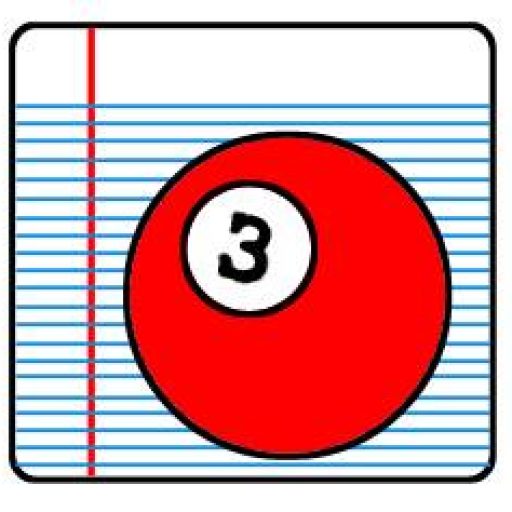



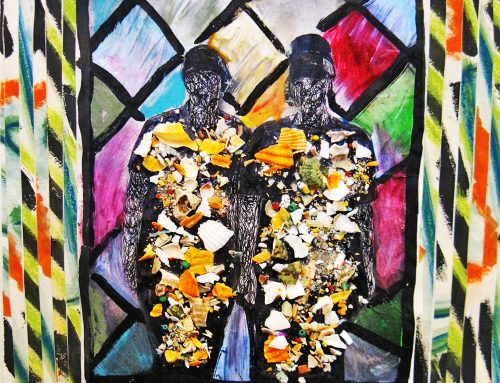
Artwork © Richard Spisak
Chapter 22

When the Ancient Greek philosopher Heraclitus said that no man walks through the same river twice I imagine that he meant that every minute that goes by the level of discrete molecules of this thing that we refer to as the conduit, or waterway, of a river, despite whatever arbitrary name we give to it, is different; and as his cynosure was exclusively that of the terrain of watery carbon mound, man, his real meaning was that no one is the same from one moment to the next. Every minute, every hour, every month, and especially every year that goes by, an individual is different both chemically and neurologically.
And thus it is, whether acknowledged or not, that a child of nine, for example, loses most of the people, pets, and possessions he once loved at eight from changes in attitudes, social expectations, and venue, and then moves to the next stage in the miraculous tragedy of growth with each year negating largely what he once was. The process is no different in later years than it had been in earlier ones, with senescence the same as all other stages of life experiences.
If upon entering the sixth decade of life, as I am, and not caring for it in the least, it at times feels like the river is running at speeds exponentially faster than at any previous stage, it would seem such as decline is more manifest, and the manifestations are imagined in greater scope than they really are because the end of life is ever more palpable to the mind. Unlike a starfish that can grow back a lost limb when caught in the estuaries of the celerity of the waters of life, one can erroneously feel that he has no ability to recover from loss in this fast-paced current, and that the so called “golden years” are a euphemism if not a mendacity. Sometimes these “golden years” seem as something that should be more attributed to yesteryear, especially when there are times of self feeling like an unmoored vertiginous agglomeration of feeling in which actuality is nothing but altering perspectives when set against a growing awareness of the limited years leading to one’s hastened departure from life.

Furthermore, the loss of a beloved friend or family member can be devastating, and, as so sensitively portrayed in Shakespeare’s Sonnet 30, the devastation can relegate him into a vestige of the self he once was, a self that seems to be withering into shadow and residue. But if the main core of himself is not so attached to people or social venues and haunts, but thought, resilience is much more vigorous and plenary; and if he contemplates the verdant beauty of nature, even though, in reality, it is composed of discrete organisms acting both as predators and asylum seekers of predation, it, like a new society to a foreign traveler, or music that blends discordant notes into a mellifluous blend, is a harmonious unity from this vantage point.
And when there is volition to do so, there can be added resilience when repudiating complacency so as to exercise mental and physical faculties as fully as possible; and likewise if there is will to do so, extreme asphyxiating forms of loneliness can be eschewed categorically even if loneliness within one’s aloneness is inevitable. It should always be remembered that as the fast paced current has the potential to bring him into an exploration of himself since he inevitably swims alone, it also can bring him into others as they also navigate similar waterways of life.
Man, like a sand castle, is fluent and solid; and the wish to think of himself as more than constant changes is a vital lie, as indispensable as water, food, and air. It is a lie of the needy creature seeking stability desperately. Such lies allow him to seamlessly exchange the boyhood illusion of permanence in family for one in which his procreative fluids can flow. Parents do not become former family so much as lesser family and this allows him to embark on that which seems more real and steady. It is an essential delusion that allows generations to emerge and others to pass away in the permutations of life. Job titles, career, and materialism make him feel as solid as a mountain and to hear his name echoed from other mountains deifies him in his own mind. And indeed, if there is one ubiquitous trait of a human, unless asphyxiating self in alcoholism or other chemical or social dependencies, it is the abject futility of shoring up that which is meant to dilapidate and collapse.
That notwithstanding, inward stabilization, substantial but in deficit never complete, can be had in the most traumatic of changes and adventitious occurrences. One integral component for achieving this is to maintain mental acuity by focusing on veracity instead of pleasant mendacities. One must, for dear life, resist succumbing to this false notion of having eternal life for it is a delusion that exacerbates senility even when offering its pleasurable placebos of mental ease to those who are getting older. Heavenly mirages abound not in nature but factitiously in the streets of every city, town, and countryside, and in every corridor of every skyscraper and hut of every continent not because eternal life is a ubiquitous truth but the delusion is too tempting. Like a kid in a candy shop in which the shop is as large and omnipresent as everlasting life, or at least as large as the planet, it is hard not to take some of the sweets.

However, abnegation is not a practice that is solely for monks, and it is a bit of secular sagacity to repudiate being delusional with sober realism. Retaining logic in all matters is the exercise and health of the brain, and as Aristotle points out logic is the only faculty that we can take pride in as setting us apart from other animals. We can admit this reality that is so obvious and so salient: we die, and deceased humans, with all things, decompose, smudge together, separate into elements, and eons later those elements lose electrons to become isotopes; and so to imagine a god waiting for the “soul” of the human animal at the pearly gates of heaven to which there is a sign that reads “No Dogs Allowed” is forfeiting rationality for senility.
And most perspicaciously, he also must resist the tendency to desperately need to believe that his life has special meaning when no such meaning have the so called heavens vouchsafed man. His mortality and decomposition is an apodictic certainty irrespective of this absurdity of imagining a soul hovering above it in order to have some everlasting purpose to the self and a pivotal purpose to the Earth that is 4.5 billion years old with billions of years of flourishing life to follow that will be beyond human hegemony. A superior man might influence a community and the community might influence a nation with the nation influencing the world, but even with this, a superior man’s impact is too negligible to measure. And even if a nation of millions were annihilated in nuclear war, it might be like the ripple of gravity waves of colliding black holes to society for a period of decades, but those ripples would dissipate in time. Everything dissipates and reassembles anew, and with enough time, electromagnetic energy changes to mass and mass to electromagnetic energy.

Time…am I really over sixty? Until recently I never felt like I was getting older. I must have thought that I was twenty perennially, and the only man on the planet who would stay such. But my ten laps of swimming daily are making me as limp as my wet trunks, unable to study and write significantly, and this continual movement in my part time janitorial work coupled with this penchant of mine for walking miles–the walk to and from a language school where I teach on Kapioloni Boulevard was a most inane idea–has aggravated venous insufficiency in my swollen legs.
Thus, here I am waiting for a bus to go to a doctor’s appointment. That left foot and leg seem to be double the girth of the other, and most freakishly, it, in my mind, looks like something that should be amputated, although less hyperbolically that which really needs amputation is my concupiscence. It was Cicero, was it not, who in his essay on aging claimed that one great advantage to aging was to at last be in possession of a brain rife in untrammeled thoughts that are no longer hostage to sexual arousal? I don’t know. Maybe Cicero was not lying. Maybe he just was not as healthy as I am, or maybe I am just a dirty old man in need of a lobotomy.
So at the bench of the temporary bus stop extension 3566 in the Kahili Valley I wait for a bus to take me to my two amputations. Here a feral chicken, prodigious in scope if not size, has ceased to be, if it ever was. Here it decomposes in a process unworthy of the involution of interwoven feathers, talons that would have scratched top soil ceaselessly to garner that which might nourish her chicks, and other intricacies that define the bird. In some ways, despite its fate with a vehicle, or some such mishap, and now that it is deceased its slow destruction from bacteria within, it, as an individual, had been born to be more impervious to harm than naked man who merges with other humans in a fellowship of convenience for comfort, prowess, and hegemony, blowing up sizable chunks of society and the ecosystem as he goes along.
And of the bird, this docile intricate being, no one would credit it as possessing soul, nor would anyone confer everlasting life upon it. It is only to be bestowed by man on man as reckless, and truculent as he is. It can almost seem unjust to deny animals a soul until one considers that no human would have one either. No words are used more and known less than “spiritual” and “soul”. They are words for a complexity greater than an internal organ or for that matter the whole organism of man, and yet it, fabrication that it is, for it isn’t even an it, has never been found. This chicken, like a deceased man or a piece of trash, decomposes and returns to smaller molecules and elements that are finally free of such conglomerations. Even elements, as stated earlier, eventually lose electrons, becoming isotopes, as nothing is meant to linger with an agenda of forever. If the most tenuous suppositions have to be drawn on our hominid predecessors based on limited bones, skulls, or fossilized content of the two, why should one be obsessed by having an everlasting significance to life when even a species can be so expunged from the planet? And why should I be upset that I am such a failure in some eyes for how can there even be success when all activity is in vain?
That the plebian masses entertain metaphysical speculations in rote prayers and fairytales is no surprise. Harder it is to fathom that most intellectuals and some, if not most, of the greatest of minds have made such blunders. Presumably, Plato believed in this eternal soul as to him it was the sole instrument that could ascertain everlasting truths and virtues. Aristotle was not much better. His concept of the Prime Mover is another wayward metaphysical speculation even if it is logical in a sense as all logic from Aristotelian syllogisms to deductive and inductive reasoning is based on cause and effect. If we were to say that Newton under the apple tree got hit by an apple and said “Hot damn, there is gravity and we aren’t floating in mid air” it illustrates the specious nature of jejune logic in mortal simpletons
Undoubtedly, logic is cause and effect and cause and effect is logic. It is man’s feeble means to make sense of the world and it is the best that human simpletons can do. Still, there have to be other frameworks holding more advanced logic that either extraterrestrials employ in their lives or that the physics of the universe congeal around. It might be less explicable than the mysterious appearance and disappearance of a quark and if we were to encounter these alternatives to cause and effect/ logic these systems might seem as thaumaturgy to our meager minds. And far from the magic of new logic are the inane, if not asinine, words of Seneca who decries any attempts to stymie his freedom to posit metaphysical speculations by saying, “Am I not to inquire how everything in the universe began, who gave things form, who separated them out when they were all plunged together in a single great conglomeration of inert matter? Am I not to inquire into the identity of the artist who created that universe or the process by which this huge mass became subject to law and order…am I not to know where I descended from, whether I am to see this world only once or be born into it again time after time, what my destination is to be after my stay here, what abode will await my soul on its release from its serfdom on earth” to which all I can say is no you are not.
It would be ignorant to ignore isolation, natural selection, sexual selection, and mutation that are the framework of evolution. It is true that there is no permanent knowledge in science since experiments can always be devised that potentially disprove an assumption, making all science somewhat theoretical, but no theory is as solidly proven as that of evolution. Certain things are almost indisputable because there is so much evidence behind it.
Definitely, microorganisms can change radically. A 30 year experiment on E. coli bacteria has proven that just in the space of three decades these microorganisms can become dramatically different when a different form of food is placed in the Petri dish. Those that got used to the changing sustenance, partially through successful mutations when under stress, were able to thrive and the others died out. Bones of whales and primitive hippopotamidae prove that at one time an early form of hippopotamus began to swim in the ocean and became whales. The theory is that they were so large and uncomfortable in moving on land that the ocean became preferable. There are so many bones of the transitional species between modern whales and an ancient form of hippopotamus that we can easily see the transformation even though it took millions of years.
There are vestige traits on human bodies such as fingernails that were probably claws, tailbones that once hung tails, hair that was probably fur, and appendixes as internal organs that have no function but probably helped in the digestion of foliage at one time as they do in primates such as chimpanzees and gorillas. Not only do computer simulations show the changes of fish to amphibian, amphibian to reptile, reptile to mammal, and chimpanzees, a mammal, to human beings, but the computer simulations are supported by the empirical evidence that fossils of human beings are found closer to the surface of the ground than fossilized fish. Everywhere around the world fossils of earlier species are found deeper in the earth.
In microbiology we know that every cell in the human body has its own DNA but also mitochondria DNA. The belief is that the first multi-cell organisms combined with bacteria in a symbiotic relationship. There are myriad other examples. So to dismiss evolutionary theory in favor of the notions that God created man in his image and that man is in possession of an everlasting soul ( why He saves the soul and allows the body to rot away a most blatant blunder in theological reasoning) is a major mistake for the only real human characteristic is our logic that helps us to understand the realities of life. Evolution is a permutation much more amazing and much more logical than the transubstantiation of bread and wine to the body and blood of Jesus Christ.
Man despite his illusions of grandeur is, of course, finite, and in this brief interregnum in which he finds himself a living entity his sole inherent purpose, obviated at present in a world too populated by his reproductive acts, is to have children who like his sexual habits are inconsequential. As for the self, it has no real importance except, during his time of being alive, affording him with a bit more autonomy than a common ant. As for my leg, less strenuous activity is the only prescription, or at least so says the doctor. As for the libido, it like the soul cannot be found let alone amputated from man and society. But then why should anything be amputated or even rearranged, just as why should discomfort be numbed? Just let me float with the current, and whatever debris I encounter will be my injury and my transformation before I finally plunge into the depths.
Steven Sills Steven Sills is a writer living in Honolulu Hawaii. There he teaches at language schools and works as a janitor. His M.A. is in great books of the Western canon.
Richard Spisak began his artistic career as a light artist in the Lumonics Studios of Mel Tanner, a legendary Light Artist. After serving under Jack Horkheimer as a planetarium operator at the Miami Space-Transit Planetarium, he left to begin traveling with Lumist Kenvin Lyman, whose show Dazzleland Studios traveled across America. Richard later worked as a Laserist with LASERIUM and Laser Productions, served as a technical producer for the festival company PACE Concerts, and later as operations Manager and Senior Producer at WWHP and WTCN-TV in Stuart Florida.
Richard writes for Theatre, TV, radio, and the web. He published two short story collections, Two Small Windows, in a Pair of Mirror Doors, and Between the Silences. Followed by his poetry collection 7370 Allen Drive and the recently released STONE POETRY. Richard also produces “POETS of the East,” a televised webcast featuring poets from across the globe.
Chapter Guide
Chapter One
Chapter Two
Chapter Three
Chapter Four
Chapter Five
Chapter Six
Chapter Seven
Chapter Eight
Chapter Nine
Chapter Ten
Chapter Eleven
Chapter Twelve
Chapter Thirteen
Chapter Fourteen
Chapter Fifteen
Chapter Sixteen
Chapter Seventeen
Chapter Eighteen
Chapter Nineteen
Chapter Twenty
Chapter Twenty- One






Leave A Comment