



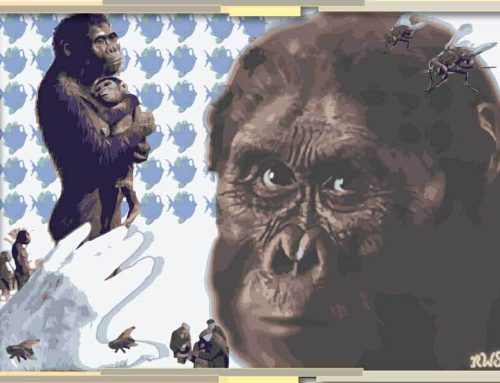
Artwork © Robert Fleming
“Where is the child who was born to be king of the Jews?” the sorcerers asked upon arriving in Jerusalem. “We observed the rising of his star, and we have come to pay him homage.” The three magi had traveled far—Balthasar from the Arabian lands of the Nabatean kings, Melchior from the empire of the Chaldeans in southern Babylonia, and Gaspar from India farther east. They are directed to Bethlehem, a sleepy village of a few hundred souls. “… [A]nd the star which they had seen at its rising went ahead of them,” Matthew continues, “until it stopped above the place where the child lay.”
Matthew is our only source for the star, which is nowhere else mentioned in the gospels. Much of his narrative, though, follows the earlier gospel of Mark. The narrative of Matthew is stirring and dramatic, as is the notion of a guiding light in the heavens pointing to the spot. These magi especially—magicians, sorcerers, and astrologers—would have been eager to canonize the event of a special birth with another event in their own domain: the enchanted heavens above. We should leave it at that. It’s fanciful, as in “visionary” rather than “imaginary.”
~~~
But for millennia, astronomers and other scientists have searched for clues, in star charts and ancient writings, for evidence of the particular source of the light that guided these three. Might a supernova have appeared? Did a new comet come into view? What about the conjunction of two planets—like Jupiter and Saturn—which would appear as a single super-bright star?
The obsession with finding scientific evidence for biblical events is broader than this. Fortunes have been spent in the search for Noah’s ark. This miraculous flood story is duplicated in other religions as well. It is in all cases a cleansing story. It wipes the human slate clean of iniquity, offering, as did the dove to Noah, an olive branch of peace.
Whether taken literally or not, these stories are worthy of a deeper contemplation not needing scientific study. The birth of a child in a remote land is such a story—the prosaic turned miraculous. The promise carried by innocence to a world fraught with despair is a powerful nostrum.
But serious rational explanations have been sought, nevertheless, as if to validate the clever mind. The issue here is not science taking legendary stories seriously; the issue is science meddling in the realm of majesty. The stories have their own dominion. Let’s set them free of scientific scrutiny!
Ron Wetherington is a retired professor of anthropology living in Dallas, Texas. He has published a novel, Kiva (Sunstone Press), and numerous short fiction and creative nonfiction.
Robert Fleming is a digital artist and visual poet from Lewes, DE. His books are White Noir, an Amazon best seller and Con-Way in 4 in 1 #4. Founding/contributing editor of Old Scratch Press and editor of Instant Noodles.





Leave A Comment