



“children are safest when firearms are stored outside the house” © Robert Fleming
The Sandwich, the Fist, and the Files
There is a city called Washington, D.C., where they say crime is out of control. You’ve seen the headlines: wave after wave of danger, chaos in the streets. The people in suits point to charts no one else sees. They talk of “taking the streets back.” They say they will save the capital from itself.
And so they deploy. Armored vehicles. Federal agents. National Guard. A campaign against lawlessness. A crackdown for the ages.
The first great battle of this war came last Tuesday, in front of a Subway sandwich shop.
The suspect: a Department of Justice employee. Not just any employee—an international affairs specialist. A man trusted with sensitive work, the kind who carries a badge that opens doors most people will never know exist.
The weapon: a wrapped footlong sub.
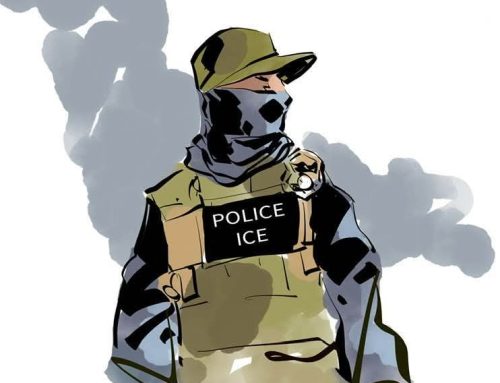
The target: a U.S. Customs and Border Protection officer.
The incident lasted seconds. There was a shout—“fascist!”—and then the sub was airborne, spinning once before striking the agent square in the chest. The paper crinkled. The mustard shifted. The mayo held fast. A collision of bread and bureaucracy.
This was no ordinary lunch. This was felony assault.
They say this federal surge was necessary. Crime, they said, was climbing the walls, filling the gutters, lurking in every alley. They said the streets ran red.
But crime in D.C. is at a thirty-year low.
Still, the convoys rolled in. The uniforms fanned out. The air smelled like authority. And now we see why: without the deployment, who would have been there to intercept the sandwich?
The official statement was simple: there will be no sanctuary for threats against officers of the law. No tolerance for violence—bread-based or otherwise.
Meanwhile, in other corners of power, the Epstein files grew colder than a meatball sub left out overnight. No statements there. No urgency. No federal surge.
In the footage, the sandwich arcs through the air like slow-motion justice. Somewhere in a federal evidence locker right now, it sits in a plastic bag, tagged, perhaps photographed from three angles. Maybe they logged the condiments. Maybe someone wrote “lettuce present.”
And we are told this is the front line in the fight for safety.
They say the crackdown was to make the capital safe from chaos. They say they must stand ready for violence. But we have seen greater violence pardoned.
Remember January 6th—-when men with flags and clubs forced their way into the Capitol. Some were dressed like weekend warriors, others like Civil War reenactors who lost the script. They were called patriots by some, forgiven by decree. They walked free.
And here is the DOJ man, in cuffs, for tossing a sandwich.
One marches on the seat of government and gets a handshake. One throws lunch and gets a felony.
This is law in America. The law flexes. The law stretches. It bends for some and snaps shut on others.
The city has been militarized. Helicopters thump over neighborhoods where the biggest threat is a jogger who doesn’t wave back. Armored trucks idle outside coffee shops. The optics are clear: the capital is under siege.
And yet, when the siege comes, it is not in the form of an armed gang or a riot—it is six inches of turkey and provolone.
They told us the streets were running red. They didn’t say it was mustard. They didn’t say the mayo was pooling at the crime scene.
We have been warned about fear before. Fear sells. Fear justifies. Fear is the curtain you pull before you shuffle the files into the back room.
The Epstein files are not a footnote here—they are the silent guest at the table. The timing is exquisite. You roll tanks into a city with crime at historic lows. You shout about law and order. And in the background, the files vanish into the basement. We are told not to look there. We are told to watch the sandwich.
The sandwich is safe. The sandwich is explainable. It has a villain and a hero. It distracts.
And in that way, the sandwich has already served the Department well.
They say no one is above the law. But watch the law in motion:
The man who threw the sandwich will be fingerprinted, charged, booked, his career ended.
The men who beat officers with poles and smashed windows on January 6th are giving interviews on cable news.
The financiers, the clients, the enablers in those locked files—untouched.
The sub is in custody. The guilty walk free.
The irony is too rich to eat. In the land of the free, you can storm the Capitol and pose for photos in the Senate chamber, but you cannot, under any circumstances, launch an Italian B.M.T. at a federal agent.
We were told this crackdown was for our safety. But whose safety?
Is America truly in danger from the man with the sandwich? Or from the men who decide which crimes matter?
A city that can mobilize hundreds of officers against condiments can surely open a file drawer. But the files are heavy. Heavier than a sub. Heavier than justice itself.
So the city tightens its grip on what it can carry—on the easy things. On the small things. On the sandwiches.
And they call it victory.
Somewhere, the DOJ man sits and wonders how it all went this way. Somewhere, a CBP officer cleans mustard from his shirt and feels the weight of valor. Somewhere, an evidence technician labels a plastic bag with the care of a jeweler.
And somewhere, deeper in the capital, a file sits in the dark, untouched.
We are told the streets are safer now. We are told the crackdown worked. We are told we must keep watch.
And we do. We watch the sandwich fly, over and over. We watch the headlines about chaos and danger. We watch the armored trucks on the evening news.
And while we are watching, the real stories pass behind us, quiet and unseen.
This is the absurdity. This is the theater. This is how you distract a city: you give it bread and call it a battle.
The mustard will wash out. The mayo will dry. The files will remain sealed.
And if there is no limit to the dictator’s ploys to bring a heavy fist down on Americans—whether with tanks or with laughter—then we must admit the truth.
The streets of D.C. have not run red with blood. Only with condiments and government spectacle.
Grady VanWright is a poet, author, and playwright based in Houston, Texas. His creative work engages themes of identity, introspection, and social consciousness through a distinctive blend of stream-of-consciousness and moderate surrealism. With over 25 years of writing experience, VanWright draws from lived history, independent scholarship, and a fascination with the psychological and cultural dimensions of the human condition. His poetry and prose have appeared in Washington Square Review (2025), The McNeese Review, South Florida Poetry Journal, Mayday Magazine, Oddball Magazine, Blood+Honey, Querencia Press, The Genre Society, The Dead Mule School of Southern Literature, Sheila-Na-Gig, and The ManifestStation Magazine. He is a member of The Authors Guild and The Poetry Society of New York.
Robert Fleming is a digital artist and visual poet from Lewes, DE. His books are White Noir, an Amazon best seller and Con-Way in 4 in 1 #4. Founding/contributing editor of Old Scratch Press and editor of Instant Noodles.






Leave A Comment