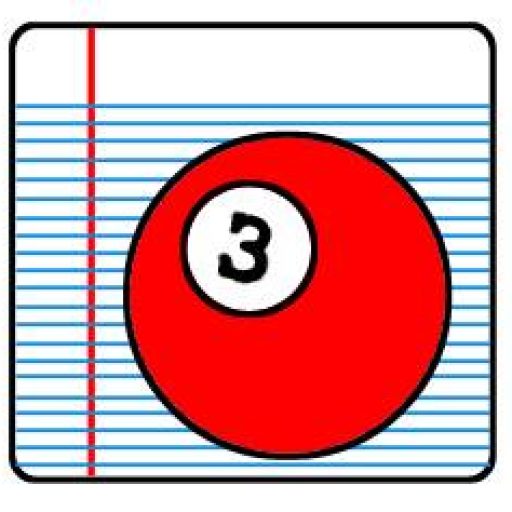



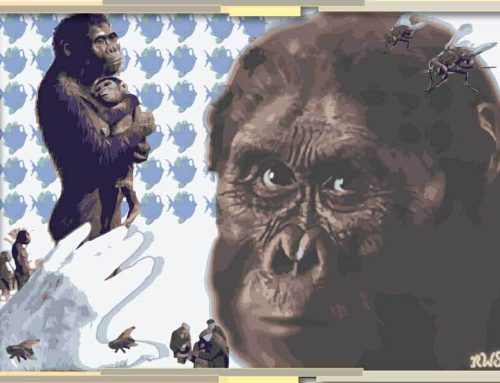
Artwork © Richard Spisak
And Then There’s Wall Street
The air doesn’t move anymore. It sits. Heavy. Thick with fear. In homes across the country, grocery trips feel like small raids—men and women staring at price tags as if deciphering codes in a war they didn’t enlist in. A bag of apples costs more than dinner used to. Gas makes you think twice before taking the long way home. You don’t plan vacations. You plan survival.
The panic doesn’t shout; it hums. Quietly. Like the sound a wire makes before it snaps.
In the Midwest, where the dirt is honest and the people are plainer than the suits who ruin their lives, farmers stand in fields of wasted hope. The soy rots. The corn stiffens in silence. They don’t burn their crops. Fire is merciful. They let them rot, slow as regret.
The tariffs, we’re told, are necessary. Necessary like amputating your foot because your shoe’s too tight. The administration promises relief checks, as if farmers asked for charity instead of fair trade. As if anyone wants pity when what they need is a buyer.
In Detroit, Toledo, and the South, the factories murmur or stop altogether. The auto lines jerk and halt like a man having a seizure. Jaguar Land Rover paused U.S. shipments, blindsided by sudden tariffs that came like thunder in a clear sky. Workers punch in, then sit in break rooms longer than they sit on the line. The machines wait for hands that don’t come. They hum to themselves, like old men in empty churches.
The open road used to be America’s dream. Now it’s a showroom of what we’ve lost. Foreign brands stall, domestic ones scramble, and cars gather dust where they used to gather pride.
And then there’s Wall Street.
The market stumbled, then fell, then rolled down the stairs drunk. The S&P dropped over 15%, a number large enough to matter but small enough to be called a “correction”—as if renaming pain makes it feel better. Retirement plans became ghost stories. Every portfolio opened read like a last will.
And the advice from the faithful? “Don’t look at your 401(k).” As if not watching your house burn means it won’t. As if someone screams from the next room, and you’re told, “Don’t go in there. It’s awful. But it’ll pass.” No. You go in. You face it. You save what you can—or you lose everything.
Because that’s what they count on: your silence, your patience, your hope. Hope is their anesthesia.
They say tariffs are patriotic. That pain now is strength later. But that’s always what they say, and it’s always someone else who bleeds. A factory worker from Ohio, a rice grower from Arkansas, a retiree in Phoenix watching her modest future vanish like smoke. They are casualties not of war, but of arrogance.
Meanwhile, the men in the suits still eat well. They call this the cost of greatness, of bringing jobs home. But the jobs never come home. They just go quiet. Like engines running out of fuel. Like factories shutting down one bulb at a time.
The tariffs came like bricks tossed through glass: loud, stupid, and unapologetic. They were policy made for applause lines, not supply chains. The economy is not a punchline. It is people. And people are bleeding—quietly, yes, but they are bleeding.
There is still time, perhaps. To stand, to shout, to refuse. But not if we keep pretending the fire is a sunset. Not if we keep saying, “It’ll pass.”
It won’t. Not unless we make the fire stop—and name who lit the match.
Grady VanWright is a poet, author, and playwright whose work blends introspection, independence, and the surreal edges of the human condition. Based in Houston, Texas, he has been writing and reading poetry for over 25 years, drawing inspiration from a lifetime of experiences and historical fascinations. His work has been published in Washington Square Review (2025), The McNeese Review, and numerous online literary journals. With a distinctive voice that merges stream-of-consciousness with moderate surrealism, Grady continues to craft evocative narratives that challenge perception and invite contemplation.
Richard Spisak began his artistic career as a light artist in the Lumonics Studios of Mel Tanner, a legendary Light Artist. After serving under Jack Horkheimer as a planetarium operator at the Miami Space-Transit Planetarium, he left to begin traveling with Lumist Kenvin Lyman, whose show Dazzleland Studios traveled across America. Richard later worked as a Laserist with LASERIUM and Laser Productions, served as a technical producer for the festival company PACE Concerts, and later as operations Manager and Senior Producer at WWHP and WTCN-TV in Stuart Florida.
Richard writes for Theatre, TV, radio, and the web. He published two short story collections, Two Small Windows, in a Pair of Mirror Doors, and Between the Silences. Followed by his poetry collection 7370 Allen Drive and the recently released STONE POETRY. Richard also produces “POETS of the East,” a televised webcast featuring poets from across the globe.


Leave A Comment